


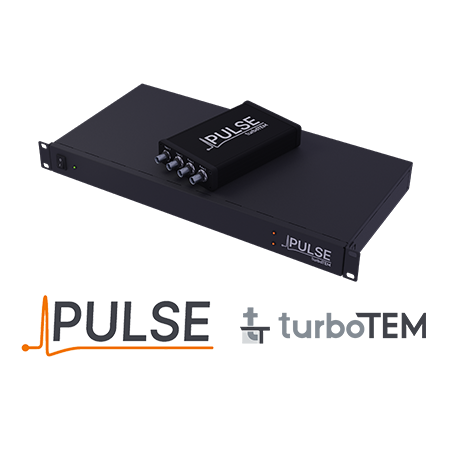
ID-04420PULSE
PULSE STEM Digital Processor (2ch)
ID-04440PULSE
PULSE STEM Digital Processor (4ch)
The Pulse system is a modular and retrofittable upgrade to improve the speed and precision of scanning transmission
electron microscopy signals. At its core, it streams the analog signal from an electron detector, including those using scintillator based technology, identifies individual electron events and returns a fully digital output. The result is images with calibrated units of individual electrons with a true zero background level and pure Poisson noise.
特長
Connects to any acquisition system accepting TTL digital inputs.
Produces quantifiable images with true zero dark level and pure Poisson noise.
Acts alongside existing detectors for simultaneous acquisition of images, including spectroscopy.
Features two channels for electron counting on two separate detectors.
仕様・オプション
| 2 Channel | 4 Channel | ||
|---|---|---|---|
| No. channels | 2 in, 2 out | 4 in, 4 out | |
| Connections | BNC | ||
| Input range | Max. ±10 V | ||
| Input resolution | 14-bit | ||
| Input impedance | 50 Ω | ||
| Sample rate | 125 Msps (per channel) | ||
| Output voltage | 3.3 V CMOS, 5 V TTL | ||
| Output frequency | Max. 62.5 MHz | ||
| Power | 5 V (USB-C or barrel jack) | ||
| Control interface | RJ45 ethernet | ||
ギャラリー
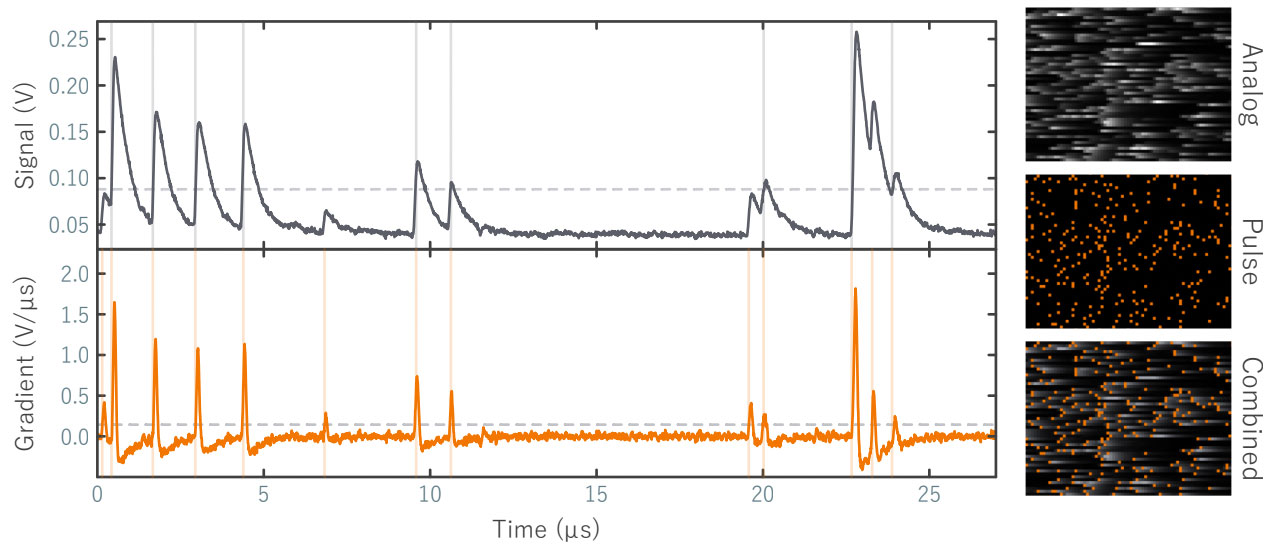
Raw data stream from a scintillator detector (top) and differentiated signal (bottom). Horizontal dashed line shows an example threshold with vertical lines showing detected electrons. Right shows high-speed, low-dose images from analog and Pulse detection, showing improved temporal response when using Pulse.
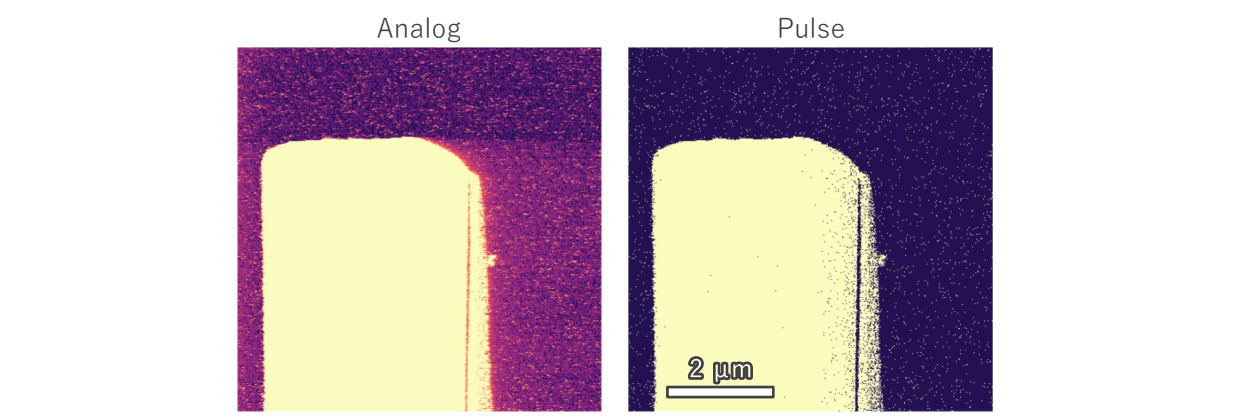
Low magnification image of a FIB lamella acquired using the analog (left) and Pulse (right) signals. Slow streaking into the vacuum can be observed in the analog signal.
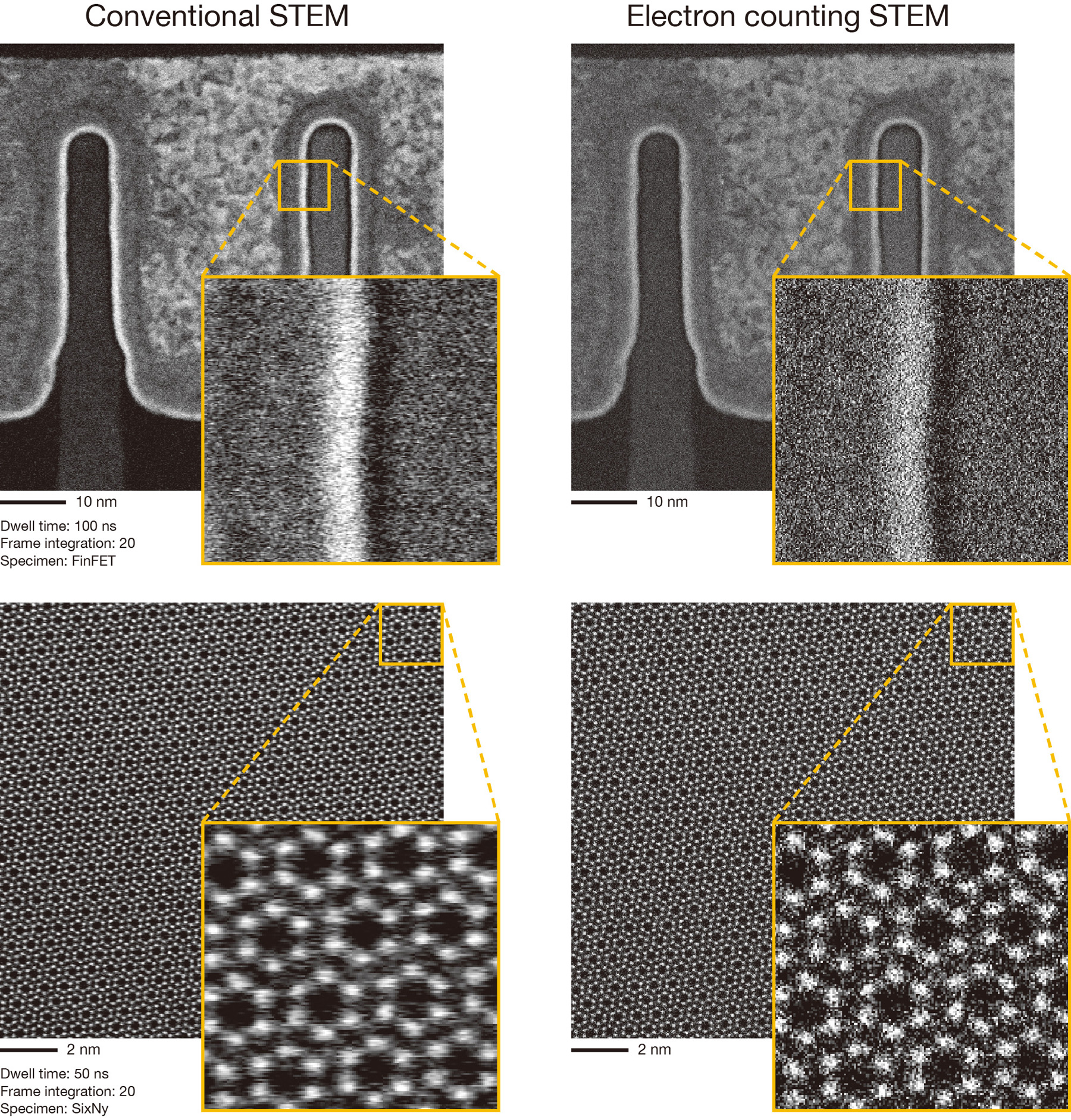
S/N improvement in STEM using the electron counting method
By equipping a transmission electron microscope with the STEM Digital Processor (ID-04420PULSE / ID-04440PULSE) attachment, it becomes possible to capture STEM images using electron counting instead of conventional analog signal processing. This technique enables the display of sharper and less noisy images, particularly during high-speed scanning, by eliminating a major source of noise as well as afterglow effects generated in the detector.
This function is also available on the higher-end Event-based Modulation System (ID-04320TEMPO / ID-04340TEMPO). However, to fully utilize the capabilities of the Event-based Modulation System, EDM Basic or EDM Synchrony is required.

