

特性X線 (EDS)
特性X線 (EDS)
characteristic X-rays
[目次:理論]
特性X線とは、入射電子によって内殻電子が原子外へ弾き出され、原子内の高いエネルギー準位にいる電子が、内殻にできたホールに遷移する際に、余剰エネルギーが電磁波として放射されるX線のことである。特性X線のエネルギーは元素によって固有の値を持つため、SEMでは特性X線を利用したエネルギー分散X線分光法(Energy Dispersive X-ray Spectroscopy)によって元素分析ができる。
特性X線の発生領域
電子線を試料に照射すると、電子は試料内部で原子と衝突しエネルギーを失いながらある深さまで侵入する。この過程で、内殻電子は弾き出され、特性X線が発生する。特性X線は試料表面から数十nm~数µmの深さの領域で発生する。
特性X線の発生領域は,入射電圧,試料の平均原子番号、原子量、密度に依存する.樹脂やガラスなど軽い元素で構成されている試料の場合は、特性X線の発生領域は深くしかも広くなる。SUS、真鍮などの重い元素で構成されている場合は、発生領域は浅く狭くなる。
図1に入射電圧20kVでカーボン(C)と銅(Cu)に電子線を入射した場合に発生する特性X線の発生領域の模式図を示す。カーボン(C)の場合、特性X線の発生領域は深さ約4.8µmである(図1a)。カーボンより遥かに重い元素である銅(Cu)の場合、特性X線の発生領域は深さ約1µm程度に減少する(図1b)。
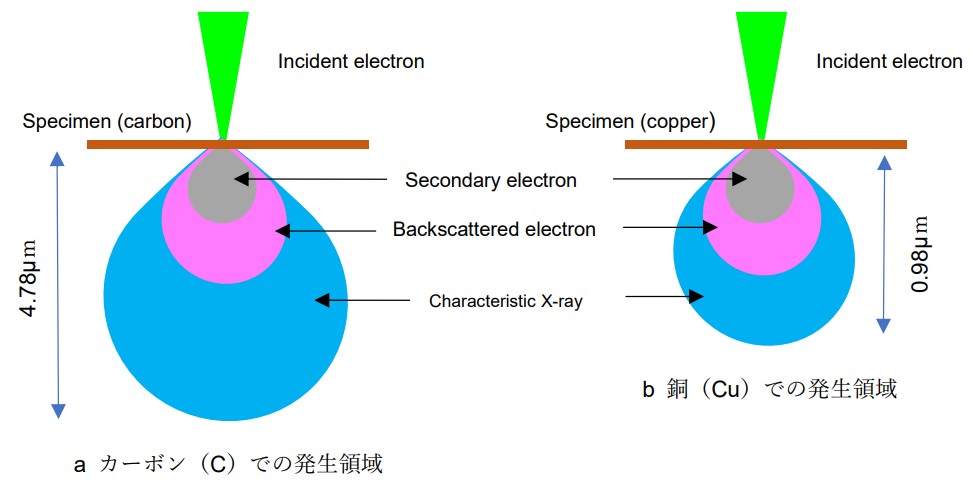
図1 カーボン(C)と銅(Cu)での特性X線の発生領域
実際に観測される特性X線強度は、発生した特性X線が試料によって吸収・散乱され、蛍光励起を起こすため、試料から脱出できるX線の深さは異なる。定量的な元素分析には、それらの効果によるX線の減衰を算定する定量補正(ZAF補正やPRZ補正)を施すが必要である。
電子ビーム照射による特性X線の発生プロセス
電子ビーム照射時におけるCu原子の特性X線発生プロセスを図2に示す。 入射電子が内殻電子と衝突すると、衝突を受けた内殻電子は原子外に弾き出される。その結果、電子軌道に空孔が発生し、原子は不安定な状態になる。安定した状態に戻ろうと、高い電子軌道にある外側の軌道にいる電子は内側の軌道へ遷移する。このときのエネルギーの差分が特性X線として放射される。L殻からK殻へ遷移した場合に放射される特性X線はKα線(図3a)、M殻からK殻へ遷移した場合はKβ線(図3b)、M殻からL殻へ遷移した場合はLα線(図3c)と呼ばれる。このように特性X線は放射に関与した電子軌道に応じて命名されている。
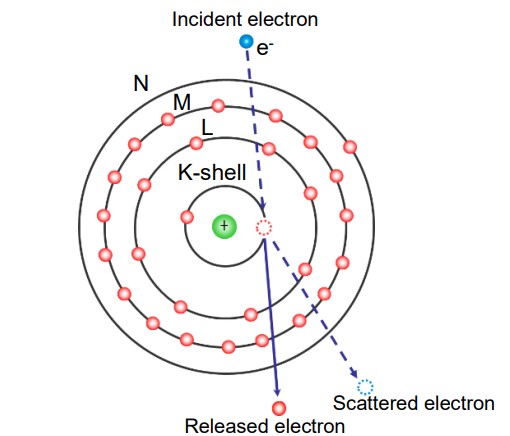
図2 Cuをモデルにした特性X線の発生プロセス
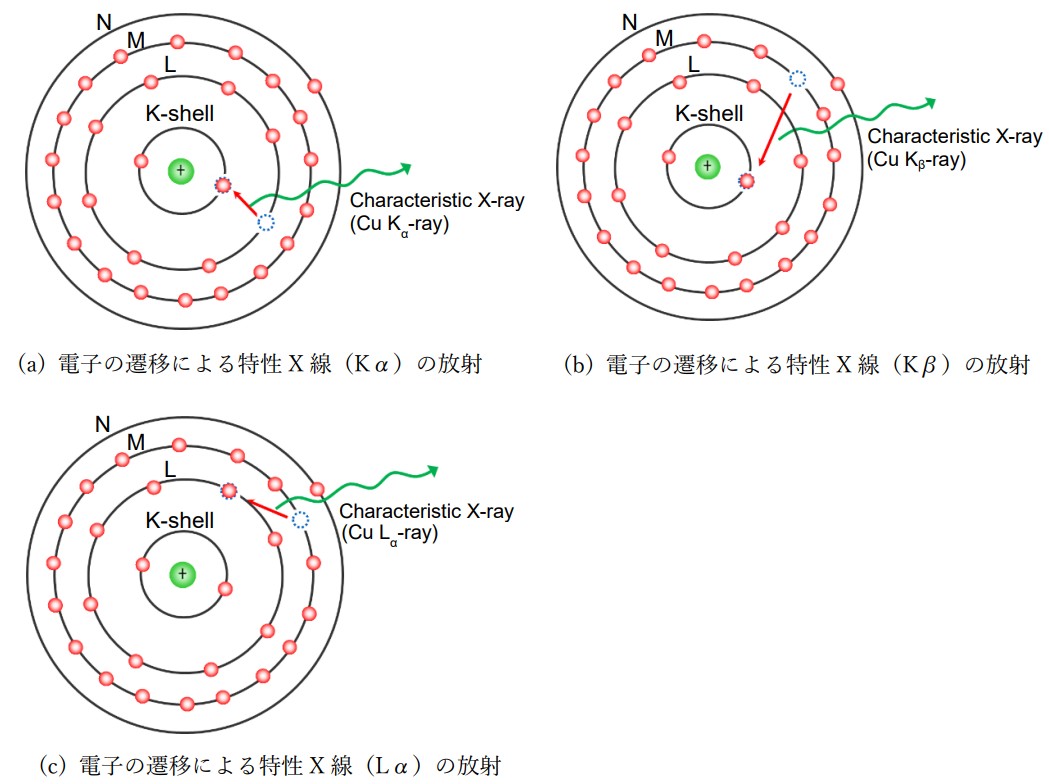
図3 Cuをモデルにした特性X線の放射メカニズム
十分な検出強度を持つ特性X線を得るための入射電圧の条件
特性X線を発生させるためには、内殻にある電子を弾き出すために必要な最小限のエネルギー(吸収端)以上のエネルギーを入射電子に与えなければならない。例として、ターゲット元素CuのK吸収端は8.979 keVであるため、理論上は入射電子の電圧は9 kV以上であればよい。しかし、十分な強度のX線スペクトルを得るためには、通常、入射電圧をターゲット元素の特性X線エネルギーの2倍程度に設定する。Cuの場合、入射電圧を15 kV程度に設定すると、十分な強度を持つKα線(8.04 keV)のスペクトルを得ることができる(図4)。
図5に原子番号の増加に伴う特性X線(Kα線とLα線)のエネルギーの変化を示す。このグラフから、15 kVの入射電圧を用いると、おおよそ全ての元素の特性X線を励起することができることが分かる。原子番号が小さい試料の場合は、入射電圧を10 kV~5 kVに下げても十分な強度のスペクトルを得ることができる。したがって、元素分析においては、試料の原子番号に合わせて、入射電圧を適切に設定して測定することが重要である。
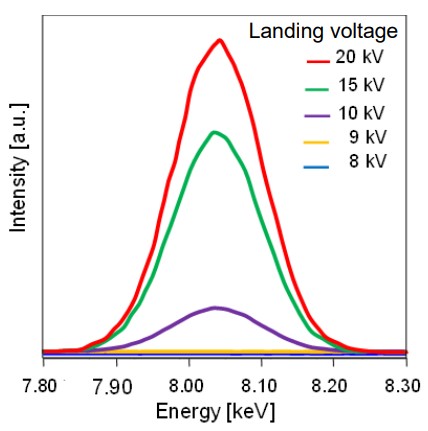
図4 特性X線Cu Kαのスペクトル強度の入射電圧依存性
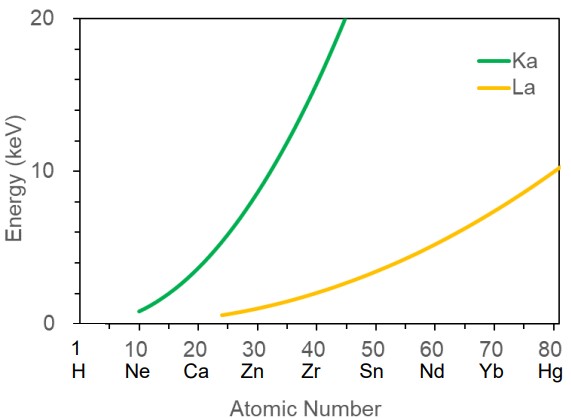
図5 特性X線のエネルギーの原子番号依存性
Characteristic X-rays are the X-rays that are emitted when an inner-shell electron is ejected from an atom by an incident electron to create a hole, and an electron at a higher energy level in the atom transitions to fill the hole, releasing the excess energy as electromagnetic radiation. Since the energy of the characteristic X-rays has a specific value for each element, SEM can perform elemental analysis by Energy Dispersive X-ray Spectroscopy (EDS) utilizing characteristic X-rays.
Generation region of Characteristic X-rays
When incident electrons irradiate a specimen, the electrons penetrate into a certain depth while losing their energy through collisions with the atoms in the specimen. In this process, the inner-shell electrons are ejected, and characteristic X-rays are generated. The X-rays are typically produced within a region ranging from several tens of nanometers to several micrometers beneath the specimen surface.
The generation region of characteristic X-rays depends on the accelerating (landing) voltage of the electron beam, the average atomic number, the atomic weight and the density of the specimen. In the case of specimens composed of light elements (e.g. resin and glass), the generation region tends to be deep and wide. To the contrary, the region becomes shallow and narrow in the case of specimens composed of heavy elements (e.g. stainless steel and brass).
Fig. 1 schematically shows the generation regions of characteristic X-ray for carbon (C) and copper (Cu) with an incident electron beam of 20 kV. For carbon, the generation region extends to about 4.8 µm in depth (Fig. 1a). For copper, which is significantly heavier than carbon, it is decreased to be about 1 µm in depth (Fig. 1b).
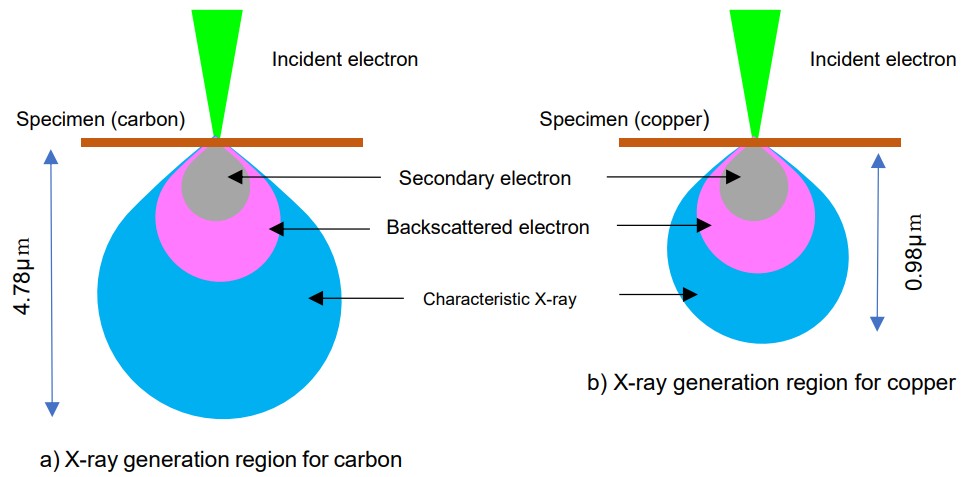
Fig. 1. Generation regions of characteristic X-rays for carbon and copper
The actually measured characteristic X-ray intensities are influenced by various effects: the generated X-rays are absorbed and scattered in the specimen and induce fluorescence excitation. Thus, the depth from which the generated characteristic X-rays can escape the specimen (called “escape depth”), is different depending on these effects. To determine accurate elemental concentrations, it is necessary to apply the quantitative corrections such as ZAF correction and PRZ correction to account for the X-ray attenuation caused by those effects.
Generation process of characteristic X-rays by electron beam irradiation
Fig. 2 illustrates the generation process of characteristic X-rays in a Cu atom irradiated by an electron beam. When an incident electron collides with an inner-shell electron, the impacted electron is ejected from the atom. Then, a vacancy or a hole is created in an inner shell orbital making the atom unstable. To return to the stable state, an electron at a higher energy orbital transitions to the hole created. At this event, a characteristic X-ray is emitted with the energy difference between the two orbitals.
When an electron transitions from the L shell to the K shell, the characteristic X-ray is called the Kα line (Fig. 3a). For the transition from the M shell to the K shell, the X-ray is called the Kβ line (Fig. 3b), and for the transition from the M shell to the L shell, it is called the Lα line (Fig. 3c). The characteristic X-rays are named according to the electron orbitals involved in their emission.
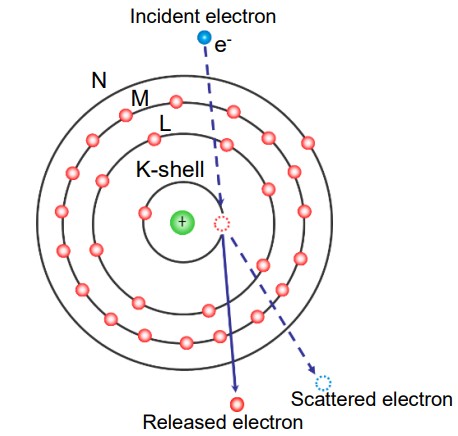
Fig. 2. Generation process of characteristic X-ray for Cu
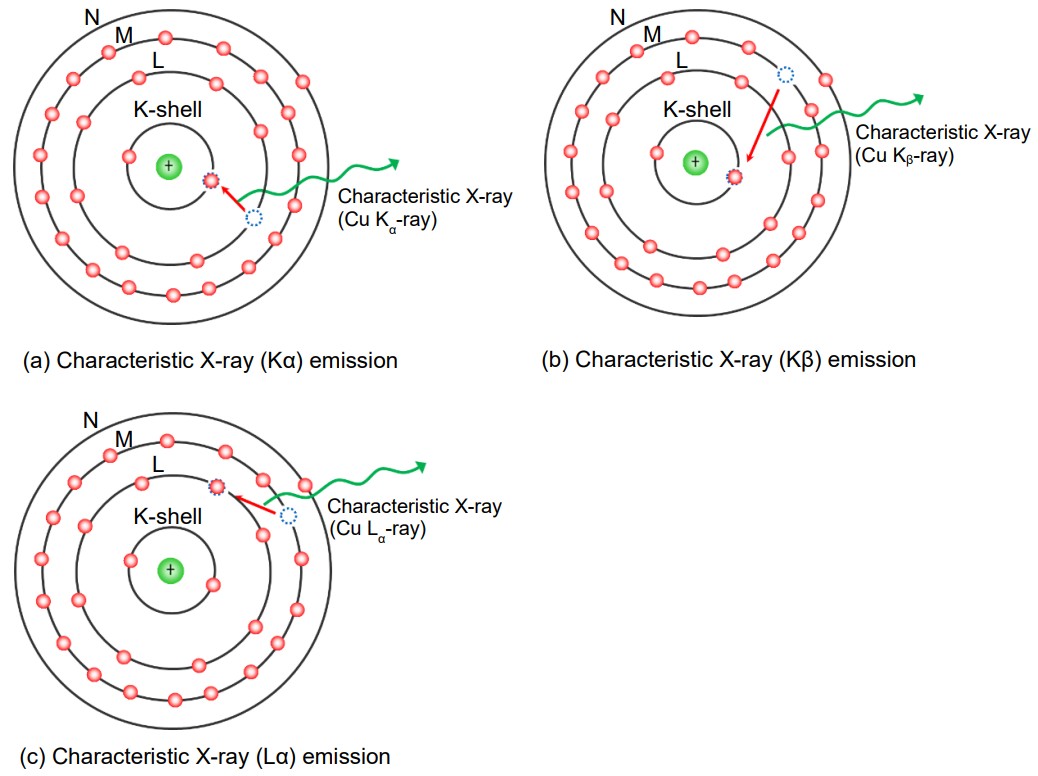
Fig. 3. Characteristic X-ray (Kα, Kβ, Lα) emissions for Cu
Conditions for incident (landing) voltage to obtain sufficient characteristic X-ray intensity
To generate characteristic X-rays, the incident electrons must have an energy equal to or greater than the minimum required to eject an inner-shell electron, known as the absorption-edge. For example, the K absorption edge of Cu is 8.979 keV; thus theoretically, an incident (landing) voltage of 9 kV or higher is sufficient. However, to obtain a spectrum with adequate characteristic X-ray intensity, it is common to set the landing voltage about twice the characteristic X-ray energy of the target element. In the case of Cu, a landing voltage of 15 kV is sufficient to obtain a high intensity spectrum of the Kα line (8.04 keV) as is seen in Fig. 4.
Fig. 5 presents how the energy of the characteristic X-rays (Kα and Lα lines) increases with atomic number. The graph indicates that a landing voltage of 15 kV is sufficient to excite the characteristic X-rays of almost all the elements. For the specimens composed of lighter elements, sufficiently high-intensity X-ray spectra can be acquired by lowering the landing voltage down to 10 kV or even 5 kV.
Therefore, in elemental analysis, it is important to properly set the landing voltage based on the atomic numbers of the specimen.
Fig. 4. Dependence of the intensity of Cu-Kα spectrum on landing voltage
Fig. 5. Dependence of characteristic X-ray energy on atomic number
関連用語から探す
説明に「特性X線 (EDS) 」が含まれている用語